
Roy Hill – Rio Tinto Mine Development
Project: Rio Tinto Mine development Stage 3
Location: Roy Hill
Client: BGC Contracting
Start: 2014
End: 2016
Value: $ 120 million
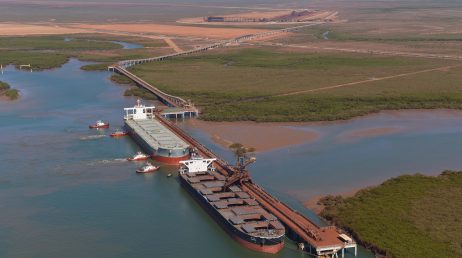
Roy Hill’s purpose built, world class iron ore port facility at Port Hedland is capable of receiving, stockpiling, screening and exporting 55Mtpa of iron ore as lump and fines and has been designed to accommodate possible future expansion.
The Port stockyard has the capacity to store over 2.3 million tonnes, with ten 230,000 tonne live stockpiles, with space to store additional material as necessary.
The Port operations are split into two separate circuits – In-loading and Out-loading.
In-loading Circuit
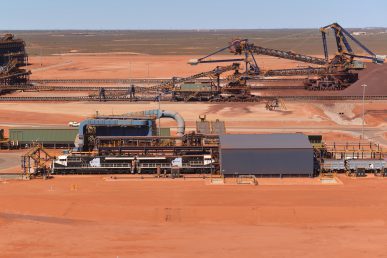
The in-loading circuit is comprised of the rail loop, car dumper, apron feeders, conveyors, two ore stackers and the Lump and Fines product stockpiles.
The Port rail loop runs around the port stockyard and is designed to allow trains to be unloaded and then depart without having to be shunted. The rail loop also protects the stockyard infrastructure from cyclonic and storm surge events as it is elevated.
Trains are unloaded through the 11,250tph rotary car dumper system, which tips two ore cars at a time in an 88 second cycle to distribute ore to either the Lump and Fines product stockpiles. Ore is distributed via four conveyors, which can directly feed either of the two 14,500tph rail mounted stackers or the screen-house and out-loading conveyor, bypassing the stockpiles to be directly loaded onto a ship.
The stackers direct ore onto the correct stockpile based on the product type and stockpile status as directed from the Remote Operations Centre in Perth. The Port stockyards ensure that Lump and Fines products are blended correctly before being shipped to customers It also provides a buffer between the Port and the Mine to ensure that ships can still be loaded even if the Port stops receiving product from the Mine for some time.
Out-loading Circuit
The out-loading circuit consists of the reclaimer, lump re-screening plant, sample station, shiploader, associated conveyors and two berth wharf.
The out-loading circuit begins with the 16,720tph bucket wheel reclaimer, which reclaims Lump and Fines products from their respective stockpiles. The ore is then conveyed via the reclaim yard conveyor to the Lump re-screening plant.
Both Lump and Fines product are processed through the Lump re-screening plant, with the Lump product being processed by the screen-house portion of the plant and the Fines product being processed through three Fines surge bins.
In the Lump re-screening plant, Lump ore passes through vibrating feeders and screens, where it is screened to separate Fines material which may have been generated through degradation during rail transportation and stockpiling. The screened Lump product is then conveyed via the 3.6km long overland conveyor to the ship-loader.
The screened out Fines product (called ‘Return Fines’) is returned via conveyor where it is stacked back onto a Fines stockpile.
The Fines product that is directed to the three Fines surge bins is fed onto the out-load conveyor where it is transferred via the transfer station, past the sample station tower and then onto the overland conveyor to the ship-loader.
The Surge bin facility is designed to ensure that the flow of product to the ship-loader is maintained at a steady rate by acting as a temporary storage, which can convert a variable rate of supply into a steady flow to the ship-loader.
The sample station periodically collects samples from the passing product stream on the conveyors. Sampling is fully automated and allows the Port Operations team to establish the quality of the product (ie grade, size distribution and moisture content).
The product then continues along the stockyard discharge conveyor and onto the overland conveyor to the wharf ship-load system.
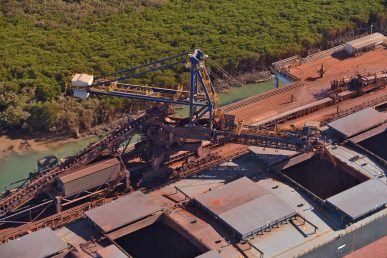
The port marine area is comprised of an elevated conveyor system and transfer stations, which transfer ore from the stockyard to the 800 metre long, two berth South West Creek Wharf. The ore is loaded into ships using a 12,700tph ship-loader, which performs a similar function to that of a stacker in that it stacks the product into a ship’s cargo hold.
Once the ship is loaded, the ship-loader is moved and the ship departs.
The delivery system between the mine and port has been carefully designed and modelled to deliver the required capacity and maintain product quality. This will ensure that Roy Hill is able to achieve its 55Mtpa capacity with a high level of confidence.